



 October 26, 2026
 No Comments
We often talk about the importance of choosing the right words. But have we considered the consequences of the things we choose not to say? Not because we are deliberately withholding information, but because we think certain details are unnecessary, too complicated or simply beyond the understanding of our audience. This happens particularly when we communicate about technology, science and innovation. We assume people will not understand the technicalities. So, we leave them out. We focus on the benefits, highlight the outcomes and simplify the explanation.
And there lies the danger. In trying to make something easier to understand, we may inadvertently change what people understand.
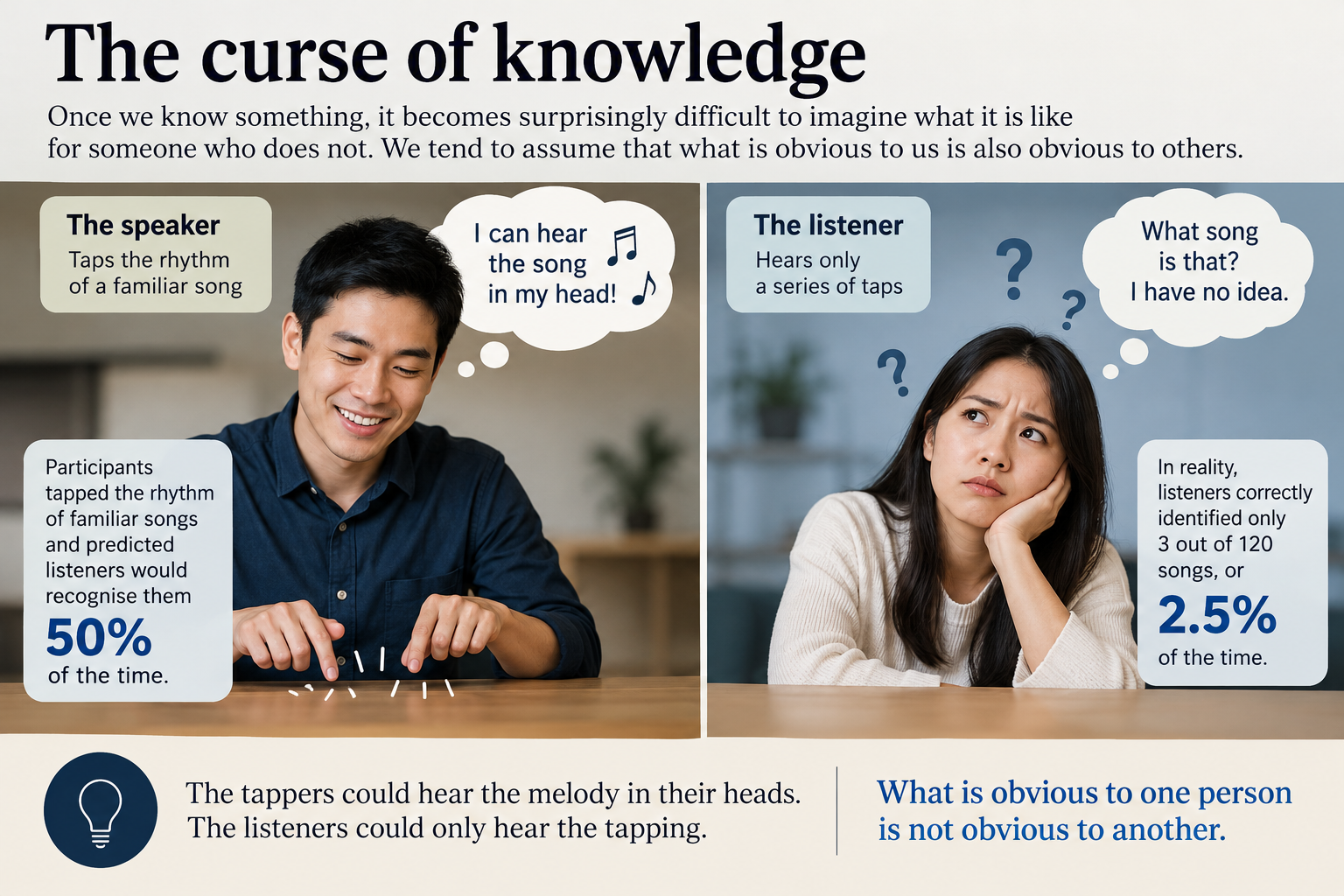
There is a psychological phenomenon known as the curse of knowledge. Once we understand something, it becomes difficult to imagine what it is like for someone who does not. In a well-known experiment conducted by Elizabeth Newton at Stanford University in 1990, participants were asked to tap out familiar songs while others tried to identify them. The tappers estimated that listeners would recognise the songs 50% of the time. In reality, only 2.5% of the songs were correctly identified.
The reason was simple. The tappers could hear the melody in their heads. The listeners could only hear the tapping. What was obvious to one was not obvious to the other. I find this particularly relevant to how businesses communicate their products, technologies and innovations.
Those developing a technology understand how it works. They know the science, the processes, the limitations and the conditions under which it delivers results. But when communicating with the public, they often leave much of this out. Sometimes, because they think the information is too technical. Other times, because they believe their audience is only interested in the benefits.
The result? We tell people what something can do without sufficiently explaining how or why.
There is an important distinction between making something simple and simplifying it. Making something simple requires effort. It means breaking down complex information, finding relatable explanations and connecting unfamiliar concepts to things people already understand.
Simply simplifying often means removing details. And when those details are essential to understanding, the message can become misleading, even when that was never the intention. Take artificial intelligence as an example. We frequently hear that AI can automate processes, increase productivity and improve decision-making. But what does that really mean?
Does automation mean replacing an entire process or supporting certain tasks within it? Does improved decision-making mean the system makes decisions independently, or that it provides information to help people make better decisions? These are important distinctions. Without them, two people can walk away from the same explanation with entirely different expectations.
And when expectations are built on incomplete understanding, disappointment, mistrust and even poor decisions can follow.
The 2025 University of Melbourne and KPMG global study on trust, attitudes and the use of AI found that 36% of respondents were unaware that common technologies they used involved AI. It is an interesting reminder that using something does not necessarily mean understanding it. Yet, how often do we assume that familiarity translates into knowledge?
The same applies to scientific breakthroughs, agricultural technologies, sustainability initiatives and even everyday business solutions. When we say a technology improves crop productivity, for example, are we explaining what happens within the plant to achieve that improvement? Are we distinguishing between results demonstrated under specific conditions and outcomes that may vary in practice?
Or are we simply communicating the most appealing result? This is where what we don’t say becomes as important as what we do. Because an omitted explanation can create an assumption. An assumption can become an expectation. And an expectation, when left unchecked, can easily be mistaken for a fact.
I believe one of the most effective ways to communicate complex subjects is through tangible examples, analogies and real-life cases. Rather than merely stating that a technology improves efficiency, show what changes in an actual working environment. Rather than claiming that an innovation increases productivity, explain the process behind the improvement and demonstrate it through an actual application.
A good analogy can help people grasp an unfamiliar concept. A case study can demonstrate how that concept works in practice. And a clear explanation of the conditions and limitations can help people form realistic expectations. But examples themselves must also be accurate. We need to cross-check the facts, verify that the analogy does not distort the science, and ensure that a particular case is not presented as a universal outcome.
Perhaps we need to be more conscious of the decisions we make when deciding what to include and what to leave out. There will always be a need to simplify communication. Not everyone needs to know every technical detail, nor should every explanation become a scientific paper. But we must be able to distinguish between details that can be omitted for clarity and details that are essential to understanding.
That requires us to understand our subject thoroughly, respect our audience’s ability to learn and take responsibility for the accuracy of the message we deliver. It also requires us to resist the temptation to make something sound simpler, easier or more impressive than it really is. Because communication is not merely about making people interested in what we have to say. It is about helping them understand what we actually mean. And sometimes, that means saying a little more, explaining a little further and checking that what we intended to communicate is indeed what has been understood.
The danger is not always in what we say incorrectly. Sometimes, it is in what we leave unsaid.
I’ve brought the argument back to your three points: we omit because we assume people won’t understand; we oversimplify and lose essential details; and we need tangible, verified examples to make the complex understandable. The central tension is now the danger of oversimplification, rather than silence or the absence of a response.

© 2026 Write Right Communications. All Rights Reserved.