



 August 11, 2026
  No Comments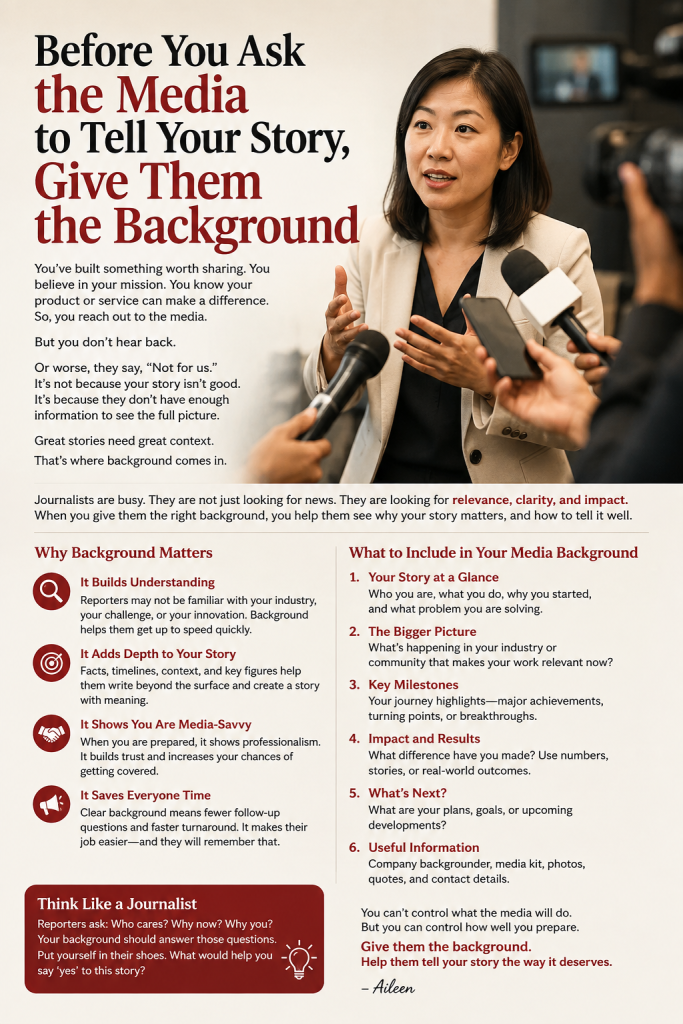
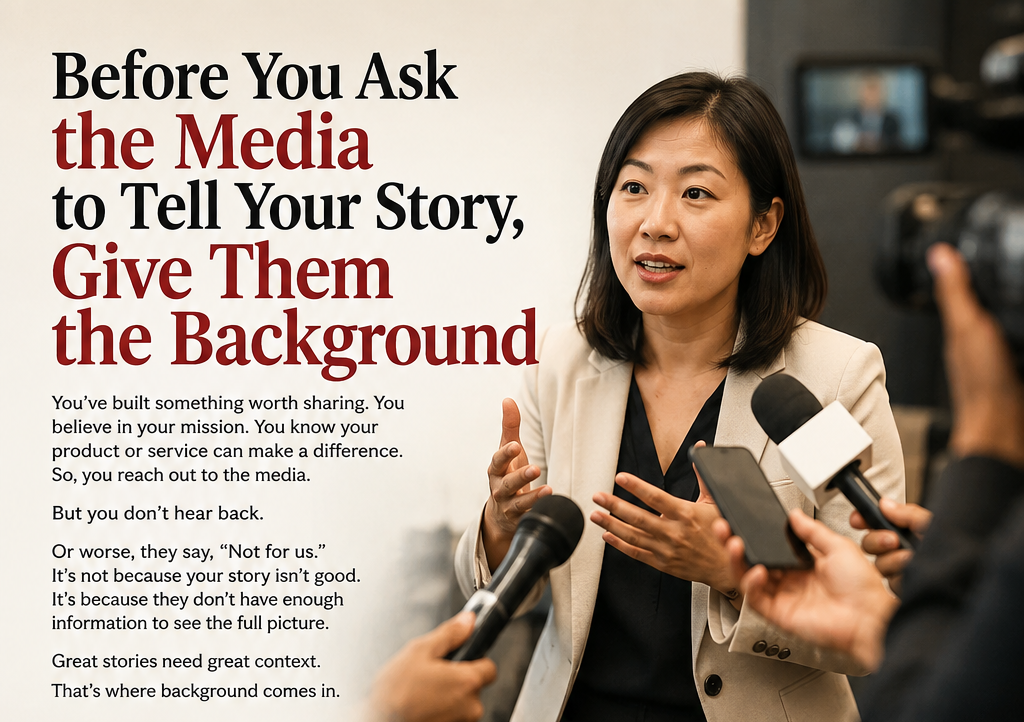
Every business owner knows their own story. You know why you started. You remember the first customer, the difficult years, the breakthrough moments, the products that worked and perhaps the ones that did not. You know what makes your company different and where you want to take it next. But here is the problem. The journalist you are speaking to does not know any of that.
And when an interview lasts 30 minutes, there is only so much ground both of you can cover. This is where one of the less glamorous—but highly valuable—pieces of business communication comes in: the backgrounder.
A backgrounder does exactly what its name suggests. It gives someone the background they need to understand your organisation before they start telling its story. It is not an advertisement. It is not a sales brochure. And it should certainly not be 15 pages of corporate language telling everyone how “innovative”, “dynamic” and “market-leading” you are. A good backgrounder answers a much simpler question: What does someone need to know to understand this business properly? Keyword: Properly.
Imagine a journalist is interviewing you tomorrow. They probably already have an angle in mind. They may have read your website, looked at your LinkedIn page and searched for previous stories about your company. But those sources often provide fragments. Your website explains what you sell. LinkedIn tells them what you have been doing recently. Previous articles tell them what somebody else considered newsworthy at a particular point in time.
The backgrounder connects the dots.
It might explain:
In other words, the backgrounder provides the context surrounding the news. And context matters. A journalist writing about your latest expansion, for example, may discover from your backgrounder that you began with three employees 15 years ago. Suddenly, the expansion is not simply another corporate announcement. It becomes part of a growth story.
A journalist interviewing your founder may discover that the business began because of a problem the founder personally experienced. Suddenly, there is a human story. A journalist covering your new technology may learn that your company spent seven years developing it. Now there is an innovation story.
Background creates perspective. Perspective creates better stories.
Because journalists work under tremendous pressure. They need to understand subjects quickly, identify what is important, check facts, find credible sources and turn information into something meaningful for their audience. The more useful information you can provide, the easier you make that process.
Cision’s 2026 State of the Media research, based on nearly 2,000 journalists across 19 markets, found that 66% of journalists rely on PR-provided content—including press releases, pitches and media kits—for story ideas. The report described PR as increasingly important to newsrooms by providing data, ideas and access to experts.
That does not mean journalists want companies to write the article for them. Far from it. It means useful, credible information has value. Cision’s previous 2025 study of more than 3,000 journalists provides another useful clue. 54% said an ideal pitch should include compelling data or statistics, while 49% wanted a unique story angle.
A strong backgrounder can help provide both. It gives journalists facts they can investigate, numbers they can contextualise and potential angles they can pursue independently. That distinction is important. Your job is not to tell journalists what exactly to write. Your job is to give them enough credible material to understand what might be worth exploring.
Business owners sometimes confuse the two. A press release answers: What is happening now? A backgrounder answers: What do I need to know to understand why this matters? Suppose your company announces a RM20 million investment in a new manufacturing facility. The press release contains the news: the investment amount, location, capacity, jobs created, launch date and comments from management.
The backgrounder provides the bigger picture.
The press release might have a lifespan of days. The backgrounder can remain useful for years, provided you keep updating it. That is why you must see it as a content asset rather than simply a PR document.
If you need us to help with your backgrounder. Just reach out to us: aileen.anthony@wrcomms.org

© 2026 Write Right Communications. All Rights Reserved.