



 June 24, 2026
  No Comments
 Many business leaders approach thought leadership as a content exercise. They focus on publishing articles, sharing opinions on social media, or commenting on industry developments. While these activities are important, they are not where thought leadership begins. Genuine thought leadership starts with a leader’s ability to articulate what they believe, why they believe it, and how those beliefs influence the way they build their business.
Throughout my conversations with founders, CEOs, entrepreneurs, and professionals across various industries, I have observed that many discuss similar topics. Growth, innovation, sustainability, leadership, talent, and customer experience frequently dominate these conversations. Yet despite using the same words, no two leaders define these concepts in exactly the same way. Their definitions are shaped by their experiences, aspirations, values, and philosophies.
That difference is what makes thought leadership valuable.
At WRComms, we often speak about the principle of Identify, Define, and Own. The same principle applies directly to thought leadership.
Leaders must first identify the ideas that matter most to them. They must then define those ideas in a way that reflects their own worldview and experiences. Finally, they must own those definitions consistently through their communication, decision-making, and actions.
Take the concept of growth as an example. One entrepreneur may define growth through market expansion and revenue. Another may define growth as creating a business that allows for a more meaningful life. A third may view growth through the lens of developing people and creating future leaders.
The word remains the same, but the meaning changes.
That meaning tells stakeholders how a leader thinks. It reveals priorities, decision-making frameworks, and the philosophy that guides the organisation.
Many organisations spend significant resources explaining what they do. Fewer spend enough time explaining why they think the way they do.
This distinction matters because products, services, and business models evolve. Customer preferences change. Market expectations shift. Technologies become obsolete. Competitive advantages that appear strong today may become irrelevant tomorrow.
A clearly articulated philosophy, however, provides continuity.
Stakeholders are increasingly interested in understanding how leaders approach challenges, opportunities, and change. They want confidence that an organisation can adapt and respond intelligently when conditions evolve. A leader’s philosophy provides that assurance because it demonstrates the thinking behind the business rather than merely describing the products being sold.
Thought leadership therefore becomes a strategic asset. It creates familiarity, trust, and credibility by helping people understand the lens through which a leader views the world.
The importance of thought leadership is no longer anecdotal. Research continues to demonstrate its impact on business performance and stakeholder trust.
Studies conducted by LinkedIn and Edelman have consistently found that high-quality thought leadership significantly influences purchasing decisions among business leaders. Decision-makers are more likely to engage with organisations that demonstrate expertise, provide meaningful insights, and contribute valuable perspectives on industry challenges and opportunities.
The same studies have shown that strong thought leadership can increase an organisation’s credibility, strengthen brand preference, and open conversations that traditional marketing often struggles to initiate.
In an environment where trust has become a critical business currency, thought leadership helps organisations earn attention through insight rather than promotion.
Many of the world’s most recognised business personalities have elevated their brands through the consistent communication of ideas rather than the promotion of products alone.
What connects these individuals is not simply expertise. Their influence stems from their ability to define ideas in distinctive ways and communicate those ideas consistently over time.
Their audiences understand what they stand for.
One of the biggest misconceptions about thought leadership is the belief that leaders need to create entirely new ideas to become influential.
In reality, many leaders are already sitting on a wealth of insights.
Board meetings, customer discussions, industry events, mentoring sessions, internal debates, and personal reflections often contain valuable perspectives. These conversations reveal patterns, lessons, philosophies, and observations that can be developed into meaningful narratives.
A single monthly conversation can generate multiple pieces of content. It can become a LinkedIn post, an article, a keynote speech, a podcast discussion, or part of a broader content series.
The challenge is not a lack of content.
The challenge is identifying the ideas worth developing and expressing them in a way that others can understand and benefit from.
Building a thought leadership engine requires more than publishing regularly. It requires a process that captures conversations, extracts insights, identifies recurring themes, and transforms those themes into narratives.
Over time, these narratives begin to reveal a leader’s philosophy. They demonstrate how the leader approaches growth, innovation, talent, customer relationships, sustainability, and business transformation.
As these perspectives accumulate, stakeholders begin to associate the leader with certain ideas and ways of thinking. That association strengthens trust, visibility, and influence.
Thought leadership is therefore not about producing more content. It is about creating greater clarity around the ideas that define who you are and how you think.
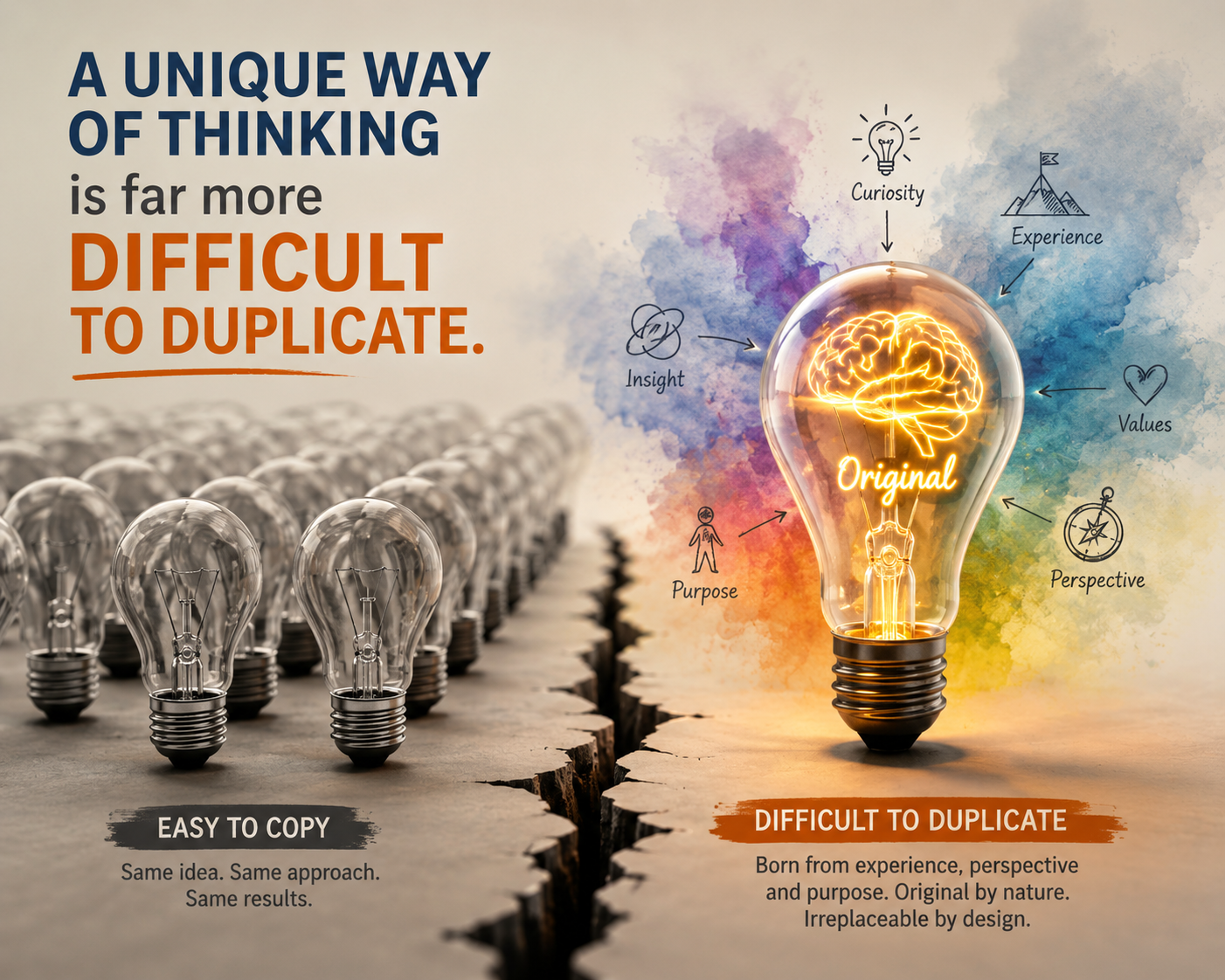
Products can be copied. Services can be replicated. Business models can be challenged.
A unique way of thinking is far more difficult to duplicate.
Leaders who identify, define, and own their ideas create an enduring competitive advantage because they give stakeholders something deeper to connect with than a product or service. They provide a perspective, a philosophy, and a framework for understanding the future.
The organisations that stand out will be those led by individuals who have the clarity and confidence to articulate what they believe and why it matters.
That is the essence of thought leadership.
It begins by identifying the ideas that matter.
It grows by defining those ideas through your own lens.
And it succeeds when you own them consistently enough that others begin to recognise them as uniquely yours.

© 2026 Write Right Communications. All Rights Reserved.