




 May 19, 2026
  No Comments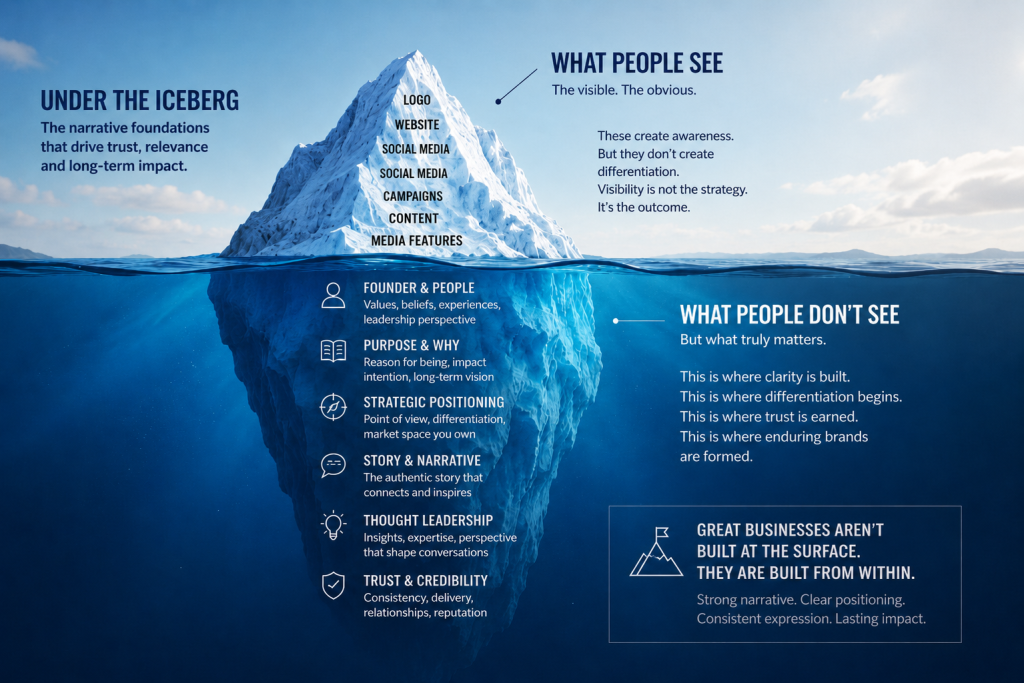
As conversations around founder branding, business storytelling, strategic positioning, and thought leadership continue to evolve, the iceberg analogy remains a powerful reminder that meaningful communication is rarely built at the surface level.
Most businesses still focus heavily on what is visible.
These are the things audiences immediately notice. They form the visible tip of the iceberg. But beneath every strong brand, trusted founder, and influential business lies a much deeper layer that often determines whether visibility translates into credibility and long-term relevance.
Today, SMEs are producing more content than ever before, yet many are struggling to create differentiation. In an environment where AI can generate articles, captions, visuals, and campaigns within minutes, visibility alone is no longer enough. The businesses that stand out are increasingly the ones that possess narrative clarity.
This is where the iceberg is relevant.
Beneath strong communication sits something deeper. It is the founder’s conviction. The business philosophy. The lived experiences behind the company. The reason the organisation exists. The patterns it observes. The problems it genuinely wants to solve. These invisible layers shape how a business communicates, whether intentionally or unintentionally.
Your audiences are becoming more sensitive to coherence. They may not always articulate it directly, but they can sense when a company is communicating from a place of depth versus simply reacting to trends. They can feel when messaging lacks alignment. They can detect when visibility is prioritised before identity is fully understood.
This is why founder and leadership branding has become increasingly important.
Your audience wants to connect with people behind the solution. Especially within SMEs and founder-led businesses, the founder often becomes part of the organisation’s trust architecture. Customers, stakeholders, investors, and even employees want to understand what drives the business at a human level.
Founder branding is often misunderstood as self-promotion. In reality, effective founder branding is about clarity and trust. It is about helping people understand the experiences, values, and perspectives that shape decision-making. It gives businesses emotional texture and human relatability.
The strongest founder brands are rarely built through manufactured visibility alone. They are built through consistency between what the founder believes, what the business communicates, and what the organisation delivers over time.
Business storytelling operates the same way.
Many businesses still approach storytelling as a marketing layer added on top of operations. But increasingly, storytelling is becoming part of strategic infrastructure. The stories a business chooses to tell influence perception, positioning, partnerships, talent attraction, and long-term brand equity.
Without strategic storytelling, businesses often fall into reactive communication. They post content because they feel they need to remain visible, but visibility without narrative direction eventually becomes fragmented noise.
Strategic storytelling asks deeper questions.
What does the business want to be known for?
What perspective does it want to own?
What future is it helping shape?
Why should stakeholders emotionally connect with the journey?
These questions sit beneath the surface, but they ultimately shape what audiences see above it.
The same applies to thought leadership.
Many businesses aspire to become thought leaders, yet few invest in the deeper thinking required to sustain authority. Genuine thought leadership is not built through motivational commentary or surface-level trends. It emerges from observation, lived experience, perspective, and the ability to articulate meaningful insights consistently over time.
Businesses that successfully build thought leadership usually possess strong internal narrative clarity. They understand their identity beyond products and services. They know what conversations they want to shape within their industries. Their communication reflects a depth of understanding rather than simply a desire for attention.
This is becoming increasingly important as digital platforms become saturated with content.
Strategic positioning is ultimately about occupying meaningful mental space in the minds of stakeholders. It is not just about being seen. It is about being remembered for something distinct and meaningful.
It requires reflection, clarity, discipline, and narrative consistency. It requires businesses to understand who they are before trying to convince the market of what they do.
The iceberg reminds businesses that the most important foundations are often the least visible. What will matter is not much content businesses push out, but how deeply its story resonates. And resonance almost always begins beneath the surface.

© 2026 Write Right Communications. All Rights Reserved.