




 September 11, 2026
  No Comments
 By Aileen Anthony
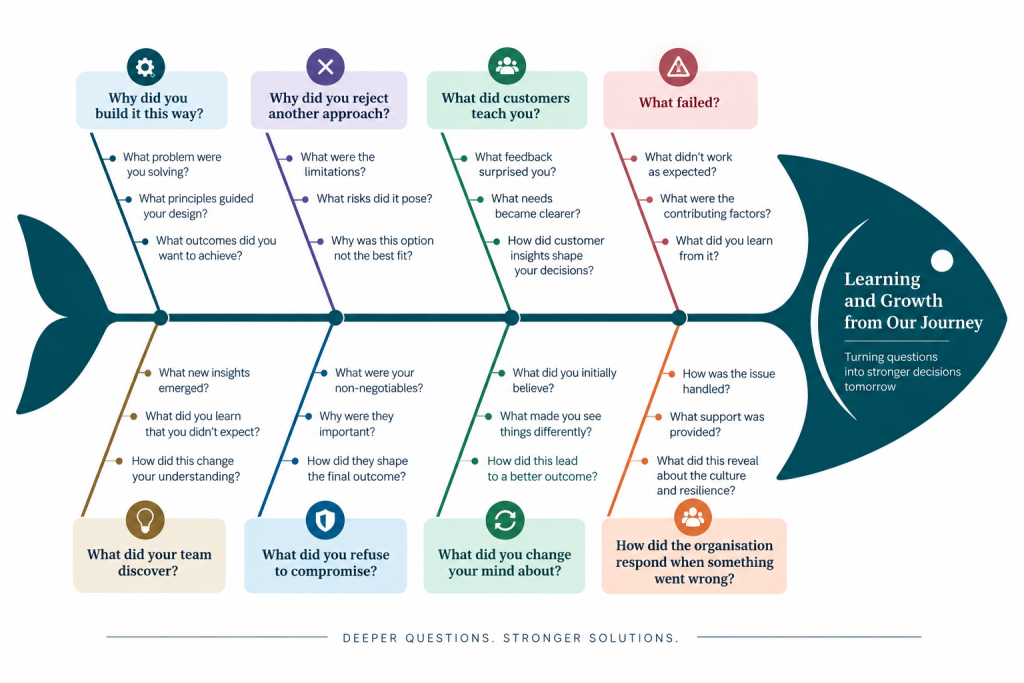
Ask a business what makes its product different and, almost instinctively, the conversation moves towards features. It is faster. Smarter. More efficient. AI powered. Easier to use. More integrated. More scalable. We list everything the product can do because we believe those features demonstrate why someone should choose us. But there is a problem.
There are more than eight billion people on this planet. Whatever you have created, there is a good chance someone, somewhere, is working on something similar. Perhaps they already have many of the same features. Perhaps tomorrow they will have more. Features can be replicated. Technology can be improved. Competitors can catch up.
So perhaps the more interesting question is not, “What does your product do?”
It is, “What is your business trying to solve?”
Your product did not magically appear. Something bothered you. Perhaps you saw customers struggling with a process that took too long. Perhaps you saw an industry doing something inefficiently. Perhaps there was a problem everybody had learned to tolerate because that was simply how things had always been done. But you saw it differently. You thought there had to be another way.
Before there was a finished product, there was probably a piece of paper, a whiteboard, a conversation or a rough drawing. You had to work out what needed to happen first, what came next, who needed to be involved, what technology was required and what had to change. At some point, you had to explain the idea to somebody. You had to say, “This is what I want. This is the problem we need to solve. This is what I want us to achieve.” Then came the hard part. You had to figure it out.
James Dyson’s story is a useful example. Dyson’s own account traces the development of its bagless vacuum cleaner to James Dyson’s frustration with a Hoover vacuum cleaner whose bag became clogged with dust and dirt, affecting its performance. After encountering cyclonic separation technology in an industrial setting, he began exploring whether the same principle could apply to a vacuum cleaner. He initially experimented with a rudimentary cardboard cyclone attached to his vacuum cleaner.
What followed was not a straight path from idea to commercial product. Dyson records that James Dyson worked through 5,127 prototypes before producing the cyclonic vacuum cleaner that would eventually underpin the business. Today, it would be easy to describe a Dyson vacuum through its suction, filtration, motor and cyclone technology.
Those are features. But they do not tell us why those features exist. The more interesting story begins with the problem Dyson was trying to solve: why should a vacuum cleaner gradually lose its ability to do what it was designed to do because its bag was clogging? The product became the answer. The problem created the journey. And the journey took thousands of attempts to figure out how to make that answer work.
Cyclonic separation is a method used to separate particles from air, gas, or liquid streams using high-speed vortex rotation and centrifugal force instead of physical filters.
We often tell business stories backwards. Once the product exists, everything that came before it begins to look strangely logical. There was a problem. Someone had an idea. They developed a solution. The product entered the market. Customers bought it. Nice, clean and linear. Except that is rarely how it happens. Someone probably told you it could not be done.
The first version may not have worked. The technology may not have behaved the way you expected. Your team may have interpreted the idea differently. The cost may have been too high. The customer may have wanted something else. So you changed something. You reconsidered an assumption. You brought in different expertise. You altered the process. You tested again. Eventually, you had something that worked. But even then, there was no full stop.
Toyota offers another interesting example: what began as solving practical problems eventually grew into a philosophy that became much bigger than any individual vehicle. The roots of the Toyota Production System go back to Sakichi Toyoda, founder of the Toyota Group, and his work on automatic looms. Toyota says Sakichi was motivated by a desire to make work easier for his mother, who operated a manual loom late into the night. His inventions did more than automate manual work. They incorporated the ability for machinery to detect abnormalities and stop, rather than continuing to produce defective products. This thinking became the foundation of jidoka, one of the two pillars of the Toyota Production System.
Then came another problem. Kiichiro Toyoda, founder of Toyota Motor Corporation and Sakichi’s son, faced the enormous complexity of automobile production. A vehicle requires thousands of parts to come together at the right time. Overproducing created waste, but missing a single necessary part could prevent a vehicle from being completed. Kiichiro developed the thinking behind Just-in-Time, where what is needed is produced when it is needed and in the quantity needed. Toyota’s historical records attribute the origins of Just-in-Time directly to Kiichiro and describe how the approach developed through trial and error as the company worked to make the production system function in practice.
What interests me is not simply the manufacturing technique. It is the thinking underneath it. A problem should become visible rather than being allowed to travel further down the production line. Waste should be questioned rather than accepted. Processes should continuously improve rather than remain fixed simply because they have always been done that way. Toyota’s own corporate history describes the foundations of the Toyota Production System as being established through repeated trial and error during the late 1940s and early 1950s, before being expanded across its plants and later its suppliers.
Toyota also continues to emphasise something particularly relevant today. As automation advances, people do not become irrelevant. Toyota’s management philosophy places people at the centre of its production system and argues that increasingly sophisticated machines still depend upon the capabilities and judgement of the people using and improving them. That brings us back to your business.
Jidoka is automation with a human touch or “autonomation,” a core principle of the Toyota Production System that means designing equipment to detect abnormalities and stop automatically.
Take the technology away for a moment. What actually brought your business this far? Was it the software, algorithm, platform or machinery? Or was it your conviction that the problem could be solved? Was it your willingness to keep asking why something was not working? Was it your refusal to compromise on standards? Was it the way you brought people together to solve each new obstacle? Was it your ability to return to the drawing board when the original idea did not work?
Technology may have enabled the solution. But your business philosophy determined how you built it. Dyson’s cyclone technology matters. But so does the willingness to work through thousands of prototypes because James Dyson remained convinced that the problem could be solved differently.
Toyota’s production technology matters. But so does the philosophy of exposing problems, eliminating waste and continuously improving how work gets done. In fact, Toyota’s own history shows that Kiichiro Toyoda emphasised that automobile manufacturing was not the work of one engineer. It emerged from accumulated research, cross-disciplinary knowledge, collective effort, and repeated failure over time.
The technology is tangible. The thinking behind it tells us something about the organisation.
This is why I find the story behind a solution so valuable when developing corporate content. Every meaningful feature should have a reason for being there. Something happened that made you build it. A customer asked for something. A process failed. An assumption proved wrong. A technical obstacle forced you to find another route. A mistake taught you something. Someone on the team asked a better question.
Instead of telling me, “Our platform has real-time reporting,” tell me why real-time reporting became necessary. What could the customer not see before? What happened because they could not see it? What did your team have to solve to make that information available? What changed for the customer afterwards? Now I am not simply learning about a feature. I am learning how your business thinks. And that is much harder to replicate.
Perhaps you have finally solved the problem. The product works. The team has delivered. Then the customer says, “We have decided to go another route.” What happens? I doubt most entrepreneurs simply shrug and give up. You start asking questions. What changed? What did we miss? What does the customer need now? How can we realign? Then you go back to the team. You rethink. You adjust. You reiterate. You test again.
Perhaps another feature emerges. Perhaps the business model changes. Perhaps you discover that the problem you originally thought you were solving was only one part of something much bigger. That response tells me something important about the organisation. It tells me how you behave when the plan does not work. And that may reveal far more about your brand than another feature list.
This is the distinction I think businesses sometimes miss. The product is visible, so naturally we communicate it. We talk about the dashboard. The platform. The algorithm. The machine. The application. The latest version. The new feature. But all of those things are outputs. Behind them are hundreds, perhaps thousands, of decisions.
Those answers begin to reveal something technology specifications cannot. They reveal the philosophy of the business.
Somewhere among more than eight billion people, someone may eventually build something remarkably similar to your product. They may have similar features. They may use similar technology. They may eventually be faster. They may even be cheaper. But they did not see the original problem through your eyes.
They did not make your decisions. They did not encounter exactly the same obstacles. They did not assemble your team. They did not have your customer conversations. They did not develop your convictions through your experiences. They did not take your journey.
So when we communicate businesses purely through its features, perhaps we are spending too much time talking about the part that is easiest for competitors to copy while leaving out the part that makes the organisation distinctive. This is why I would change the question. Instead of only asking, “What features make our product different?”, ask, “Why did we build them in the first place?” Then go deeper. What were we trying to solve? What did we encounter along the way? What did those challenges teach us? What does the way we solved them reveal about who we are?
Technology may enable your product. Features may demonstrate its capabilities. The solution may create commercial value. But the process of figuring it out reveals your philosophy, values, resilience, judgement and the way you do business. Your product shows me what you built. Your journey shows me how you think. That is where real brand differentiation begins.

© 2026 Write Right Communications. All Rights Reserved.