




 September 8, 2026
 No Comments
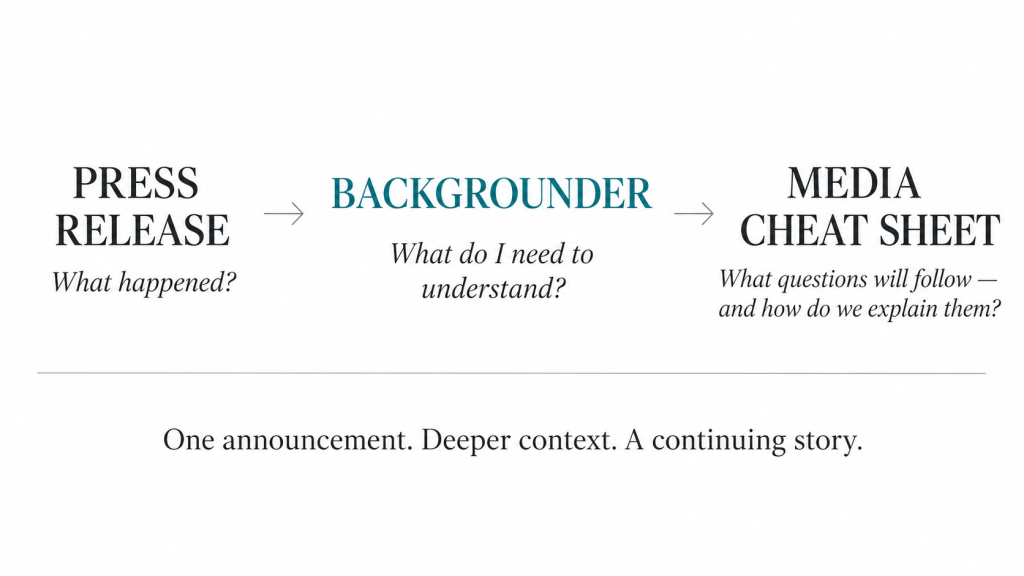
I covered the backgrounder PT1 PT2 a few weeks back. In this post, I want to explain how a backgrounder, media cheat sheet and press release come together. If the Media Cheat Sheet is the “Q&A beyond the press release,” the Backgrounder is the story behind the press release. A press release tells journalists what has happened. The backgrounder helps them understand how the organisation arrived here, what sits behind the announcement and why the development matters. Traditionally, a corporate backgrounder supplements a news release by providing company history, leadership information, products or services and important milestones. It is commonly included as part of a wider media kit.
Not every journalist covering an organisation will understand its business, technology, sector or history. This becomes particularly important when dealing with complex subjects such as AI, agritech, biotechnology, sustainability, finance or emerging business models. The announcement itself may be straightforward, but understanding its significance often requires considerably more context.
The backgrounder fills that gap. Instead of forcing every press release to explain the organisation from the beginning, it gives journalists a separate reference point. This allows the release to concentrate on what is new, while the backgrounder explains what they need to know to understand the business behind what is new. This reflects the broader role of a media kit: giving journalists useful information about an organisation so they can write a clear, comprehensive story.
The backgrounder should therefore not become another corporate profile. A conventional company profile often tells us when the company was established, what it offers and where it operates. A stronger backgrounder connects those facts into a narrative.
It should help answer:
The real value of the backgrounder becomes clearer over time. One press release may announce a partnership. Another may cover an expansion. The next could involve funding, technology, research, customers or impact. Viewed individually, these are separate announcements. The backgrounder provides the connecting thread.
It creates what we can call narrative continuity — allowing journalists and other stakeholders to see each development as another chapter in a larger journey rather than an isolated piece of corporate news. That also means the organisation does not have to repeatedly introduce itself. Every new announcement should move the story forward rather than restart it.
This is where I would take the concept slightly beyond the traditional PR backgrounder. Traditional guidance generally describes backgrounders as relatively brief documents, often around one or two pages. For our purposes, however, a more comprehensive Master Backgrounder is valuable.
The master version becomes the organisation’s deeper repository of external-facing context: its origins, evolution, leadership, proposition, milestones, technology or methodology, industry context, evidence, partnerships, impact and future direction.
We do not necessarily send the entire document every time. Instead, relevant sections can be extracted depending on the story, journalist or stakeholder. The organisation therefore builds the knowledge once and deploys it selectively.
The two documents consequently perform complementary roles.
The Backgrounder helps someone understand. The Media Cheat Sheet helps someone explain.
The backgrounder establishes history, context, meaning and continuity. The cheat sheet anticipates questions and provides clear explanations, supporting facts and responses.
And the press release has an even narrower responsibility: tell me what happened.
Together, the communications architecture becomes very clear:
Press Release → What happened?
Backgrounder → What do I need to understand about it?
Media Cheat Sheet → What questions are likely to follow, and how do we explain them?
Ultimately, the backgrounder should become more than a media attachment. It can serve as the source of contextual truth for external storytelling — the reference from which corporate profiles, media materials, website narratives, award submissions, speaker profiles, briefing documents, thought leadership and future cheat sheets can be developed.
That creates consistency without forcing every piece of communication to sound identical. The announcement changes. The audience changes. The story develops. But the underlying history, facts, positioning and narrative remain anchored. The simplest way to define the roles of the different documents: The press release creates the news. The cheat sheet prepares us for the questions. The backgrounder makes sure there is a bigger story behind both.
The discussion on the Backgrounder draws on established public relations and media-relations practice. These are useful references:

© 2026 Write Right Communications. All Rights Reserved.